
Class 11 Biology Short Notes 2026-27 (CBSE) | All 5 Units
The complete chapter-wise guide 1,50,000+ students trust — Diversity in the Living World to Human Physiology, every key concept & diagram in one place.
📗 Get the Short NotesJuly 14, 2026
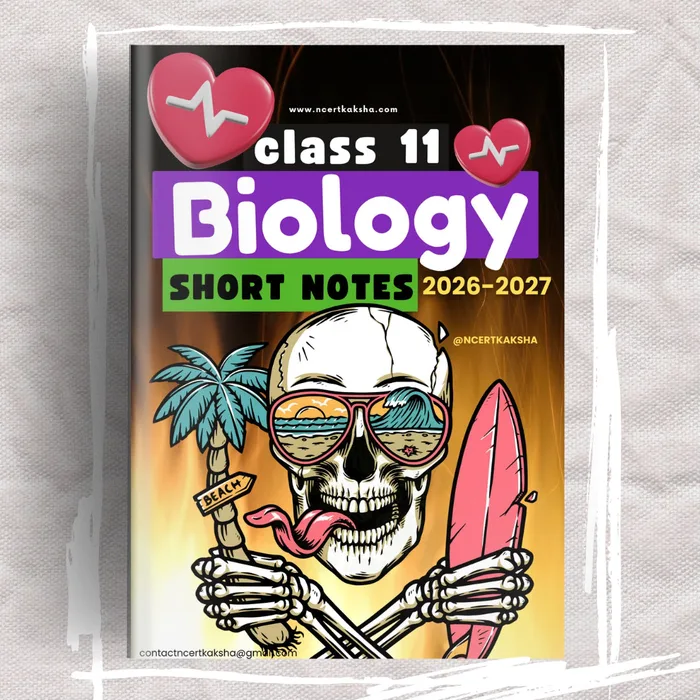
Class 11 Biology is a memory marathon — thousands of terms, classifications, cycles, and diagrams. Unlike Physics or Maths, there are no formulas to lean on; every mark depends on recalling the right term or drawing the right labelled diagram. The students who win are the ones who revise from compact, visual notes instead of re-reading a 400-page textbook.
This guide maps the essentials of every Class 11 Biology unit for CBSE 2026-27 — the same map inside the NCERT Kaksha Biology Short Notes, handwritten by IITians, NITians, and NEET toppers.
📌 What's in this guide
Why Class 11 Biology Is Your NEET Foundation
Nearly half the NEET Biology paper draws on Class 11 topics — Cell Biology, Plant and Human Physiology, and the diversity classifications. Build this base well and NEET prep becomes revision; build it poorly and you re-learn it under pressure in Class 12. Because Biology is recall-heavy, the format you revise from matters more than in any other subject.
What's Inside the NCERT Kaksha Biology Short Notes
- ✅ All 5 CBSE 2026-27 units — Diversity to Human Physiology
- ✅ 101 pages of colour-coded, handwritten notes
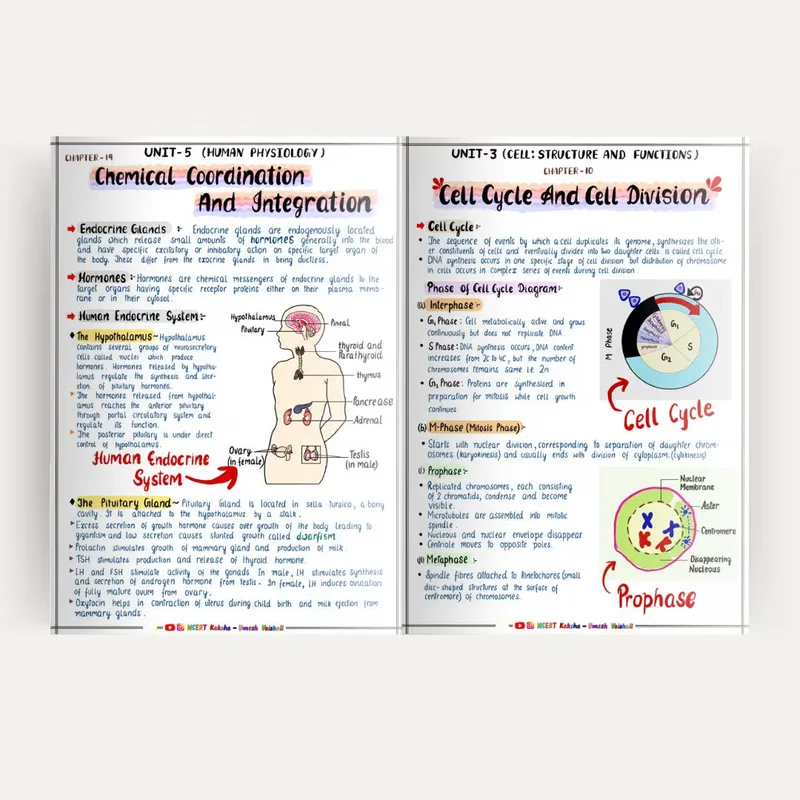
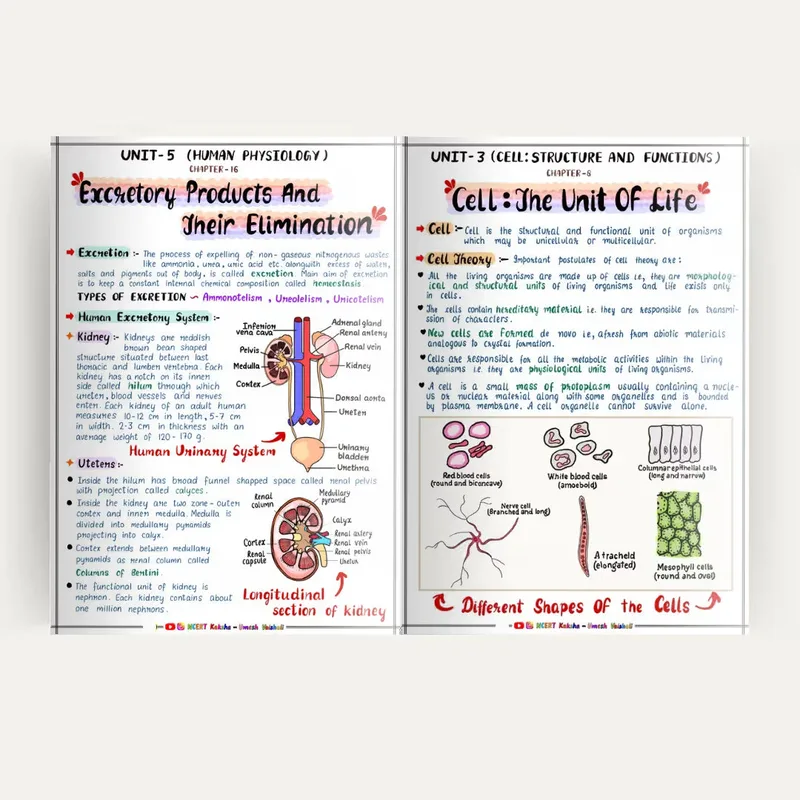
- ✅ Labelled diagrams for cells, tissues & physiology systems
- ✅ Classification tables & flowcharts for quick recall
- ✅ A5 pocket size (21.2 × 14.8 cm)
- ✅ Made by IITians, NITians & NEET toppers
- ✅ Digital notes, on your email in minutes · Combos: Bio, Phy+Chem, PCB, PCMB
See How Colourful & Organized the Notes Actually Are
All 5 Units — Key Topics You Cannot Skip
1Diversity in the Living World
Covers: The Living World, Biological Classification, Plant Kingdom, Animal Kingdom. Focus on: the five-kingdom classification, taxonomic hierarchy, and characteristic features of each phylum — the highest-frequency recall area.
2Structural Organisation in Plants & Animals
Covers: Morphology & Anatomy of Flowering Plants, Structural Organisation in Animals. Focus on: root/stem/leaf modifications, types of tissues, and the cockroach/frog systems as diagram-heavy scoring topics.
3Cell: Structure and Function
Covers: Cell — The Unit of Life, Biomolecules, Cell Cycle & Cell Division. Focus on: organelle functions, enzyme action, and the phases of mitosis & meiosis — a NEET favourite.
4Plant Physiology
Covers: Photosynthesis, Respiration in Plants, Plant Growth & Development. Focus on: the light & dark reactions, glycolysis/Krebs cycle steps, and plant hormones — process-recall heavy, so flowcharts help most.
5Human Physiology
Covers: Breathing & Exchange of Gases, Body Fluids & Circulation, Excretory Products, Locomotion & Movement, Neural Control, Chemical Coordination. Focus on: the organ-system diagrams and their functions — the largest and most tested unit.
How to Use the Short Notes the Right Way
Sirf notes khareedne se marks nahi milte. This is how our top Class 11 students use them:
1. Prioritise Human Physiology (Week 1)
It's the largest, most-tested unit. Revise its diagrams and system functions first.
2. Redraw diagrams from memory (daily)
Biology marks live in labelled diagrams. Cover the labels and redraw the cell, nephron, heart, and neuron until you can do them blind.
3. Build recall with classification tables
Use the five-kingdom and phylum tables for daily 10-minute recall drills. Repetition beats re-reading.
4. Two cold passes before exams
One full pass a month out, one 20-minute pass the exam morning.
Keep an "Error List" — the habit that saves 5+ marks
Note the terms and diagram labels you keep confusing. In the final week, read only this list.
Traditional Revision vs. Short-Notes Revision
| Approach | Textbook | NK Short Notes |
|---|---|---|
| Time to revise full Biology | 12–15 hours | 60–75 minutes |
| Diagram recall | Scattered | All labelled in one place |
| Classification tables | Buried in text | Ready flowcharts |
| Portability | Heavy books | A5 pocket size |
| Cost | Textbook + notes | From ₹149 |
What Real Class 11 Students Are Saying
Class 11 Biology Handwritten Notes 2026-27
"Thank you very much🙏it is very colour full and neat labelled diagram is very nice 👏 Thank you❤️"
— Thara"One of the best recommendation one'll ever get, go for this with closed eyes"
— Kiran Kumar"really a best resource to understand biology ncert."
— Dipankar Dey638 reviews · 4.6-star average · 75% five-star
Frequently Asked Questions
How many units are there in Class 11 Biology for CBSE 2026-27?
There are 5 units — Diversity in the Living World, Structural Organisation in Plants & Animals, Cell: Structure & Function, Plant Physiology, and Human Physiology.
Which is the best short notes for Class 11 Biology?
The NCERT Kaksha Class 11 Biology Short Notes — 101 pages, all 5 units, colour-coded and handwritten by IITians and NEET toppers.
How many pages is the Class 11 Biology notes book?
101 pages of handwritten, chapter-wise notes covering the complete CBSE 2026-27 Biology syllabus.
Which unit is most important in Class 11 Biology?
Human Physiology is the largest and most heavily tested unit, both in boards and NEET. Give it the most revision time and diagram practice.
Is Class 11 Biology important for NEET?
Yes — nearly half the NEET Biology paper draws on Class 11 topics like Cell Biology, Plant and Human Physiology, and the diversity classifications, making it a crucial foundation year.
How will I get it?
It is digital. Your notes reach your email and your WhatsApp within minutes of paying.
How long does full Biology revision take with the notes?
Designed for fast revision. Most students finish one full pass of all 5 units in about 60–75 minutes, and an exam-day pass in under 30.
Is there a discount?
Yes. Free gifts come with every order. Combos (PCB, PCMB) save more for multi-subject students.
Ready to Win the Biology Memory Marathon?
Join 1,50,000+ students who trust NCERT Kaksha for revision.
From ₹149Free gifts with every order
📗 Order Biology Short Notes NowAlso in combos: PCB · PCMB · Phy+Chem