
Class 12 Economics Short Notes 2026-27 (CBSE) — Micro + Macro, Every Concept & Formula
The complete chapter-wise guide 1,50,000+ students trust — Consumer Equilibrium to Balance of Payments, every concept, formula & diagram in one place, revise in under an hour.
📘 Get the Short NotesJuly 14, 2026
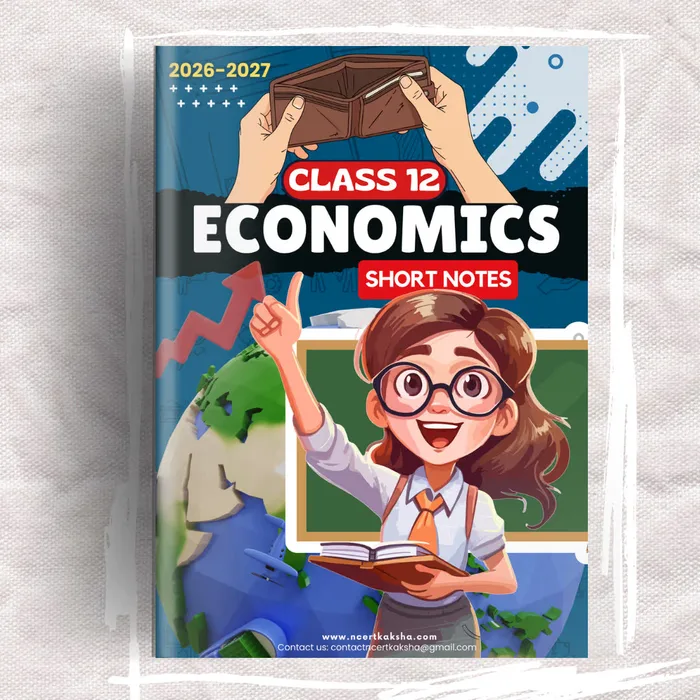
Class 12 Economics is deceptively broad — Micro is diagram-and-concept heavy (demand, supply, market forms), while Macro mixes definitions with a handful of must-know formulas (national income aggregates, the multiplier, government budget). Students lose marks not from lack of understanding but from mixing up definitions, forgetting a formula, or drawing a diagram slightly wrong under exam pressure.
This guide maps the essentials of the whole Class 12 Economics course for CBSE 2026-27 — the same map inside the NCERT Kaksha Economics Short Notes, handwritten by district toppers.
📌 What's in this guide
Why Class 12 Economics Is Two Subjects in One Paper
Microeconomics rewards diagram accuracy and conceptual clarity (consumer equilibrium, elasticity, market forms). Macroeconomics rewards definitions plus formula fluency (national income methods, the investment multiplier, budget concepts). The two halves need slightly different revision styles — and a good short-notes book separates them cleanly so you don't blur Micro concepts with Macro aggregates.
What's Inside the NCERT Kaksha Economics Short Notes
- ✅ Complete CBSE 2026-27 syllabus — Microeconomics + Macroeconomics
- ✅ 82 pages of colour-coded, handwritten notes
- ✅ Concepts, diagrams & all key formulas in one place
- ✅ Board-important questions & definitions highlighted
- ✅ A5 pocket size (21.2 × 14.8 cm)
- ✅ Made by District Toppers, NITians & IITians
- ✅ Digital notes, on your email in minutes · Combos: Eco, Eco+Acc, Eco+BST, Eco+Acc+BST
See How Colourful & Organized the Notes Actually Are
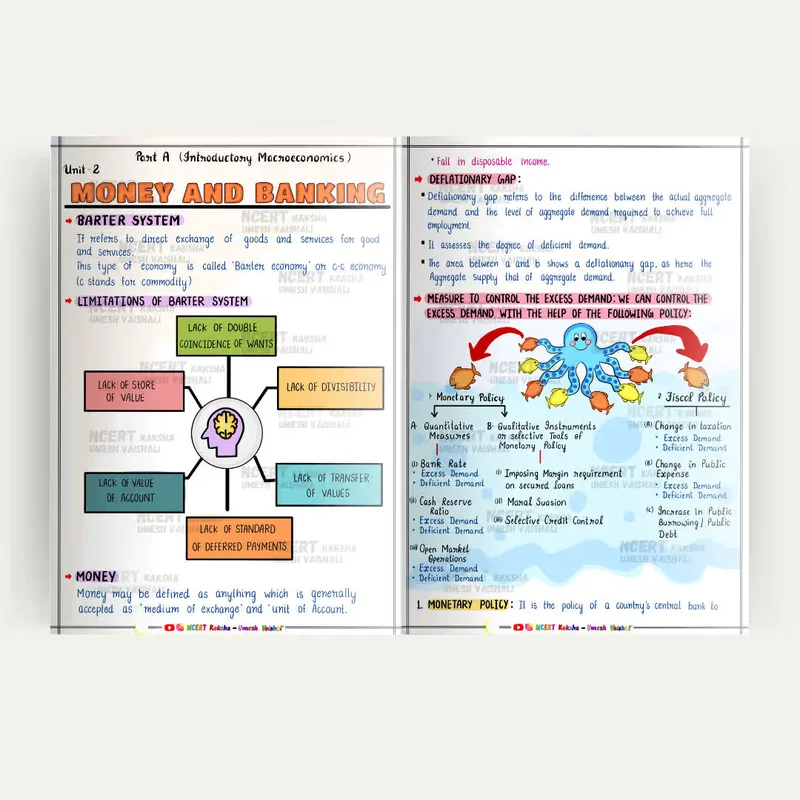
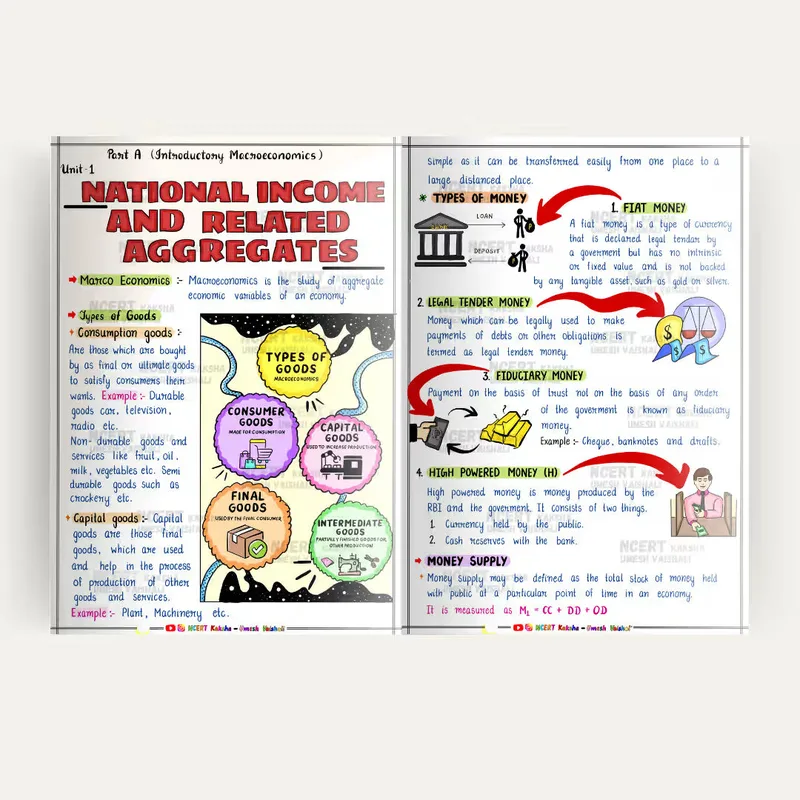
Full Syllabus — Key Concepts & Formulas You Cannot Skip
Part A — Introductory Microeconomics
1Consumer Equilibrium & Demand
Focus on: utility analysis, indifference curves, and the law of demand.
2Producer Behaviour & Supply
Focus on: production function, returns to a factor, and cost & revenue curves.
3Forms of Market & Price Determination
Focus on: perfect competition, monopoly, monopolistic & oligopoly features, and market equilibrium with the effects of shifts in demand & supply — the most diagram-heavy Micro topic.
Part B — Introductory Macroeconomics
4National Income & Related Aggregates
5Money and Banking
Focus on: functions of money, commercial banks' credit creation, and the central bank's functions & tools.
6Determination of Income & Employment
7Government Budget & the Economy
Focus on: budget objectives, revenue vs. capital budget, and types of deficits.
8Balance of Payments & Foreign Exchange
Focus on: the current & capital account, autonomous vs. accommodating transactions, and the determination of the foreign exchange rate.
How to Use the Short Notes the Right Way
Sirf notes khareedne se marks nahi milte. This is how our top Class 12 students use them:
1. Split Micro and Macro (Week 1)
Revise Micro (diagrams & concepts) and Macro (definitions & formulas) in separate sittings so you don't blur the two halves.
2. Lock the formula-heavy Macro topics
National income aggregates, the multiplier, and budget deficits carry the numericals. Drill these formulas until they're automatic.
3. Redraw the key Micro diagrams
Demand-supply equilibrium and the market-form diagrams win marks. Practise drawing them cleanly and labelled.
4. Two cold passes before boards
One full pass a month out, one 20-minute pass the exam morning.
Keep an "Error List" — the habit that saves 5+ marks
Note the definitions and formulas you keep confusing (APC vs. MPC, the deficit types). In the final week, read only this list.
Traditional Revision vs. Short-Notes Revision
| Approach | Textbooks | NK Short Notes |
|---|---|---|
| Time to revise full Economics | 8–11 hours | 40–55 minutes |
| Formulas in one place | Scattered | Single section |
| Diagrams | Buried in text | Colour-coded, ready to copy |
| Portability | Two NCERT books | A5 pocket size |
| Cost | Textbooks + guides | From ₹149 |
What Real Class 12 Students Are Saying
Class 12 Economics Handwritten Notes 2026-27
"Very useful and they are perfect for last-minute revision."
— Aradhya"Let me go through them, i will surely give rating 🙏🏻"
— Kamal292 reviews · 4.6-star average · 100% five-star
Frequently Asked Questions
What is the Class 12 Economics syllabus for CBSE 2026-27?
It has two parts — Introductory Microeconomics (consumer equilibrium, producer behaviour, forms of market) and Introductory Macroeconomics (national income, money & banking, income determination, government budget, balance of payments) — in one 80-mark paper.
Which is the best short notes for Class 12 Economics?
The NCERT Kaksha Class 12 Economics Short Notes — 82 pages covering full Micro + Macro with concepts, diagrams and formulas, handwritten by district toppers.
How many pages is the Class 12 Economics notes book?
82 pages of handwritten, chapter-wise notes covering the complete CBSE 2026-27 Economics syllabus.
Which topics are most important in Class 12 Economics?
National Income aggregates, Determination of Income & Employment (the multiplier), and Forms of Market carry a large share of marks, so prioritise them first.
Do the notes cover both Microeconomics and Macroeconomics?
Yes — both parts are covered chapter-wise in one book, with the concepts, diagrams and formulas each half needs.
How will I get it?
It is digital. Your notes reach your email and your WhatsApp within minutes of paying.
How long does full Economics revision take with the notes?
Designed for fast revision. Most students finish one full pass in about 40–55 minutes, and an exam-day pass in under 30.
Is there a discount?
Yes. Free gifts come with every order. Commerce combos (Eco+Acc, Eco+BST, Eco+Acc+BST) save more.
Ready to Master Both Halves of Economics?
Join 1,50,000+ students who trust NCERT Kaksha for board revision.
From ₹149Free gifts with every order
📘 Order Economics Short Notes NowAlso in combos: Eco+Acc · Eco+BST · Eco+Acc+BST