



The Best NEET Chemistry + Biology + Physics Handwritten Notes
3 books · Full colour · 72 chapters
- Revise a chapter in 15 Minutes
- Made by District Topper, NITian & IITian
- 72 chapters & 7 free gifts
- ₹PayUPI · Cards
- ✉Email + WhatsAppInstantly
- 📖Start revisingTonight
- ↗Better marksRevise a chapter in 15 minutes
Superb......... Must buy... Very helpful for neet aspirants
Easy to read and understand and the theory was too good and explainable and examples were too conceptual and better for beginners who have lost their…
must buy to crack neet 2027 .all d best to every neet aspirant
it has covered all the topics needed for neet
Beautiful and excellent to crack NEET EXAM
Excellent for formula revision and application practice.
Why Choose Our Formula Sheet / Short Notes?
Overcome these challenges and boost your marks
- Vast SyllabusStruggling to cover and revise key formulas.
- Time PressureDifficulty balancing school and Self Preparation.
- Exam StressRisk of forgetting crucial formulas under pressure.
- Resource GapsLack of concise & organized study materials.
- Expertly DesignedCreated by toppers, IITian, NITian, NEET rankers.
- Visual LearningColor-coded with diagrams for enhanced retention.
- ConciseRevise a chapter in 15 Minutes.
- Exam FocusedAlso included the formulas which are asked in Board Exams & popular competitive exams.
This Formula Sheet / Short Notes help you to score more in your Board Exams.
Chemistry, Biology and Physics in One Pack
Every book has its own chapters and quick revision pages. Here is what is inside each one.
Open the book. These are the real pages.
Straight from the book, nothing redrawn. Tap any page to zoom.
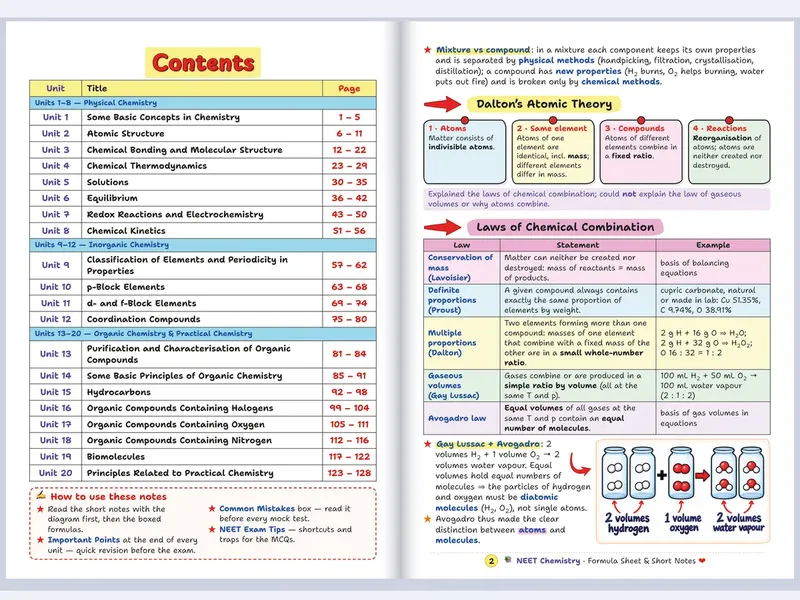
Contents page and a page on Dalton's atomic theory and the laws of chemical combination.
The boxes students revise first
Built into the chapters. Tap a box to zoom.
A table of the symbols used in the chapter and what each means.
Short revision points at the end of each unit.
A table of the chapter’s key terms and their meanings.
Short revision points at the end of each chapter.
A table of the symbols used in the chapter and what each means.
The unit’s formulas in one table, with a note on each.
1 of 6
All 72 chapters, and what each one covers
Tap a chapter to see its topics.
1. Some Basic Concepts in ChemistryChemistry
Matter and Its Nature, Dalton’s Atomic Theory, Laws of Chemical Combination, Atomic and Molecular Masses, Mole Concept and Molar Mass, Percentage Composition, Empirical and Molecular Formula, Chemical Equations and Stoichiometry, Reactions in Solutions: Concentration Terms.
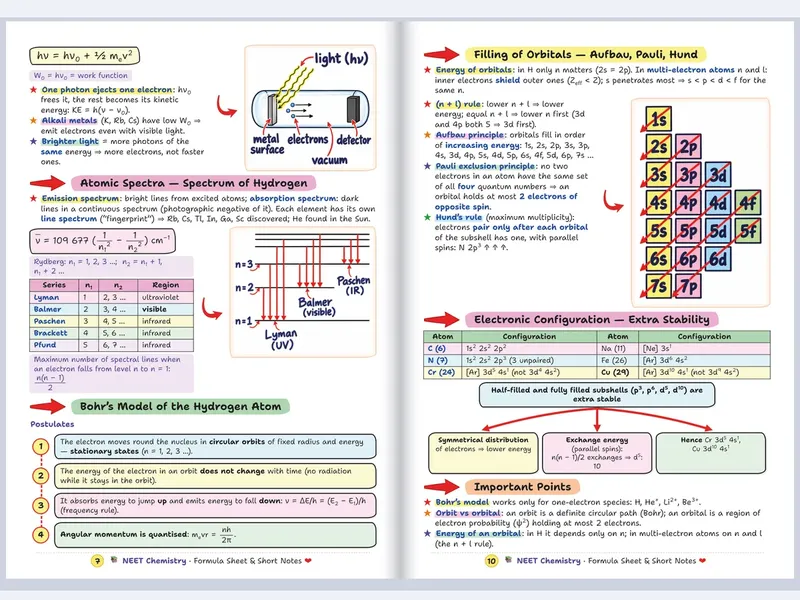
2. Atomic StructureChemistry
Electromagnetic Radiation and Planck’s Quantum Theory, Photoelectric Effect, Atomic Spectra: Spectrum of Hydrogen, Bohr’s Model of the Hydrogen Atom, Dual Nature of Matter and the Uncertainty Principle, Quantum Mechanical Model of the Atom, Quantum Numbers, Filling of Orbitals: Aufbau / Pauli / Hund, Electronic Configuration: Extra Stability.
3. Chemical Bonding and Molecular StructureChemistry
Kossel–Lewis Approach to Chemical Bonding, Limitations of the Octet Rule, Ionic (Electrovalent) Bond, Bond Parameters, Dipole Moment, VSEPR Theory: Shapes of Simple Molecules, Hybridisation, Molecular Orbital Theory (MOT), Hydrogen Bonding.
4. Chemical ThermodynamicsChemistry
System / Surroundings and Types of System, State Functions: Extensive and Intensive Properties, Internal Energy and the First Law, Pressure–Volume Work, Heat Capacity and Calorimetry, Enthalpy Change of a Reaction, Hess’s Law of Constant Heat Summation, Gibbs Energy and Spontaneity, Gibbs Energy Change and Equilibrium Constant.
5. SolutionsChemistry
Expressing the Concentration of Solutions, Molarity and Molality, Vapour Pressure and Raoult’s Law, Ideal and Non-ideal Solutions, Azeotropes, Colligative Properties, Osmotic Pressure, Abnormal Molar Mass and van’t Hoff Factor.
6. EquilibriumChemistry
Equilibrium: a Dynamic State, Equilibria in Physical Processes, Law of Chemical Equilibrium: Kc and Kp, Factors Affecting Equilibrium, Ionic Equilibrium: Electrolytes / Acids and Bases, Ionization of Water and the pH Scale, Hydrolysis of Salts and pH of their Solutions, Buffer Solutions, Solubility Equilibria of Sparingly Soluble Salts.
7. Redox Reactions and ElectrochemistryChemistry
Oxidation and Reduction: Electronic Concept, Oxidation Number, Types of Redox Reactions, Balancing Redox Equations, Metallic and Electrolytic Conduction, Electrochemical Cells: Daniell Cell, Electrode Potentials and the SHE, Nernst Equation / Equilibrium Constant and ΔG, Batteries and Fuel Cells.
8. Chemical KineticsChemistry
Rate of a Chemical Reaction, Rate Law / Rate Constant and Order, Molecularity and Mechanism, Integrated Rate Equations, Temperature Dependence: Arrhenius Equation, Collision Theory, Effect of a Catalyst.
9. Classification of Elements and Periodicity in PropertiesChemistry
Modern Periodic Law: Present Form of the Periodic Table, Atomic Radius, Ionic Radius, Ionization Enthalpy, Electron Gain Enthalpy, Electronegativity, Valence and Oxidation States, Anomalous Properties of Second-Period Elements, Periodic Trends and Chemical Reactivity.
10. p-Block ElementsChemistry
p-Block: General Features, Group 13: Boron Family, Group 14: Carbon Family, Group 15: Nitrogen Family, Group 16: Oxygen Family (Chalcogens), Group 17: Halogens, Group 18: Noble Gases.
11. d- and f-Block ElementsChemistry
Trends in the First (3d) Series, Oxidation States and Electrode Potentials, Magnetism / Colour / Catalysis / Complexes / Alloys, Potassium Dichromate / K2Cr2O7, Potassium Permanganate / KMnO4, Inner Transition (f-Block) Elements.
12. Co-ordination CompoundsChemistry
Werner’s Theory, Key Terms and Ligands, IUPAC Nomenclature (Mononuclear Complexes), Isomerism in Coordination Compounds, Bonding: Valence Bond Theory, Crystal Field Theory (CFT), Importance of Coordination Compounds.
13. Purification and Characterisation of Organic CompoundsChemistry
Methods of Purification, Chromatography, Qualitative Analysis: Detection of Elements, Quantitative Analysis (Basic Principles), Dumas / Kjeldahl and Carius Methods, Empirical and Molecular Formula.
14. Some Basic Principles of Organic ChemistryChemistry
Carbon: Tetravalence and Shapes, Structural Representations, Classification of Organic Compounds, Isomerism, Bond Fission and Reactive Intermediates, Nucleophiles and Electrophiles, Resonance and the Resonance (Mesomeric) Effect, Electromeric Effect and Hyperconjugation, Types of Organic Reactions.
15. HydrocarbonsChemistry
Classification / Isomerism and Nomenclature, Alkanes: Preparation and Properties, Conformations of Ethane, Alkenes, Alkynes, Aromatic Hydrocarbons: Benzene, Directive Influence of Groups on Benzene.
16. Organic Compounds Containing HalogensChemistry
Classification and Nomenclature, Nature of the C–X Bond, Preparation of Haloalkanes and Haloarenes, Physical Properties, Haloalkanes: Nucleophilic Substitution, Optical Isomerism: Stereochemistry, Elimination and Reaction with Metals, Haloarenes: Reactions, Polyhalogen Compounds: Uses and Effects.
17. Organic Compounds Containing OxygenChemistry
Alcohols / Phenols / Ethers: Classes / Structure, Preparation of Alcohols and Phenols, Acidity of Alcohols and Phenols, Reactions of Alcohols; 1° / 2° / 3° Tests, Reactions of Phenols, Ethers, Reduction / Oxidation and Tests, Carboxylic Acids.
18. Organic Compounds Containing NitrogenChemistry
Amines: Structure / Classes and Names, Preparation of Amines, Basic Character of Amines, Reactions and Tests for 1° / 2° / 3° Amines, Electrophilic Substitution in Aniline, Diazonium Salts.
19. BiomoleculesChemistry
Carbohydrates: Classification, Glucose, Disaccharides: Constituent Monosaccharides, Proteins, Enzymes, Vitamins, Nucleic Acids, Hormones (General Introduction).
20. Principles Related to Practical ChemistryChemistry
Detection of Extra Elements (Lassaigne’s Test), Tests for Functional Groups, Chemistry of Preparations, Titrimetric Analysis, Qualitative Salt Analysis: Anions, Qualitative Salt Analysis: Cations, Chemical Principles of the Experiments.
1. The Living WorldBiology
What is Living?, Diversity and Nomenclature, Rules of Binomial Nomenclature, Classification / Taxonomy and Systematics, Taxonomic Categories (Hierarchy), Biodiversity, Metabolism.
2. Biological ClassificationBiology
Systems of Classification, Kingdom Monera, Kingdom Protista, Kingdom Fungi, Kingdoms Plantae and Animalia, Viruses / Viroids / Prions / Lichens.
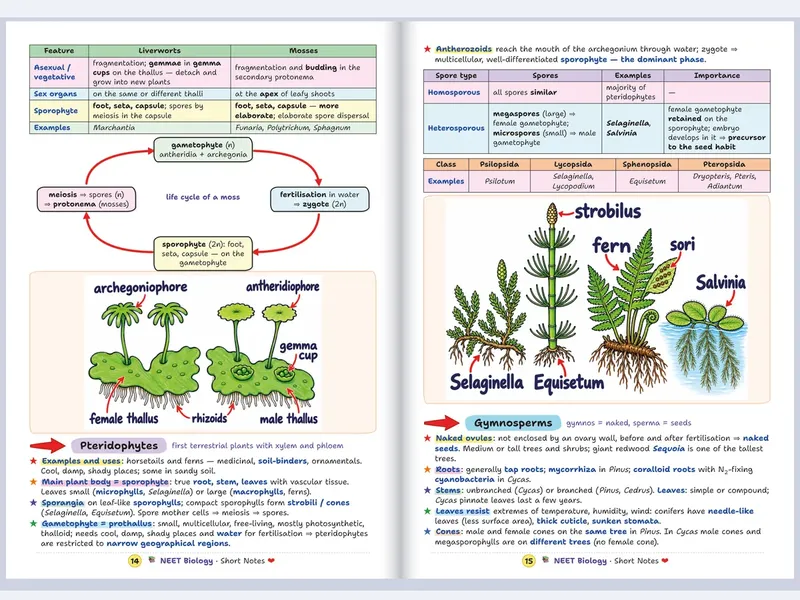
3. Plant KingdomBiology
Systems of Plant Classification, Algae, Bryophytes, Pteridophytes, Gymnosperms, Bryophytes vs Pteridophytes vs Gymnosperms.
4. Animal KingdomBiology
Basis of Classification, Phyla Compared, Non-chordate Phyla, Porifera (sponges), Coelenterata (Cnidaria), Arthropoda, Mollusca, Phylum Chordata.
5. Morphology of Flowering PlantsBiology
The Root, The Stem, The Leaf, Inflorescence, The Flower, Fruit and Seed, Floral Formula and Families.
6. Anatomy of Flowering PlantsBiology
Plant Tissues, Simple Permanent Tissues, Complex Tissues: Xylem and Phloem, Xylem: water and minerals Phloem: food, The Tissue Systems, Anatomy of Root, Anatomy of Stem, Anatomy of Leaf.
7. Structural Organisation in AnimalsBiology
Animal Tissues, Epithelial Tissue, Connective Tissue, Muscle Tissue, Neural Tissue, Frog: Digestive System, Frog: Respiration / Circulation / Excretion, Frog: Control / Coordination and Senses, Frog: Reproduction.
8. Cell: The Unit of LifeBiology
What is a Cell?: Cell Theory, Prokaryotic Cells, Cell Membrane, Cell Wall, Endomembrane System, Mitochondria: power houses, Chloroplasts, Ribosomes / Cytoskeleton / Cilia and Centrioles, Nucleus.
9. BiomoleculesBiology
How to Analyse Chemical Composition, Amino Acids, Lipids and Nucleotides, Primary and Secondary Metabolites, Proteins, Enzymes, How Enzymes Speed Up Reactions, Factors Affecting Enzyme Activity, Classification of Enzymes.
10. Cell Cycle and DivisionBiology
Cell Cycle, Interphase, M Phase: Mitosis, Prophase / Metaphase / Anaphase and Telophase, Cytokinesis, Meiosis, Significance of Mitosis.
11. Photosynthesis in Higher PlantsBiology
What is Photosynthesis?, Early Experiments, Where does Photosynthesis Take Place?, Pigments Involved, Light Reaction, Chemiosmotic Hypothesis, Where are ATP and NADPH Used?, Photorespiration, Factors Affecting Photosynthesis.
12. Respiration in PlantsBiology
Respiration: Basics, Glycolysis, Fermentation, Aerobic Respiration, Electron Transport System and Oxidative Phosphorylation, The Respiratory Balance Sheet, Amphibolic Pathway, Respiratory Quotient (RQ).
13. Plant Growth and DevelopmentBiology
Seed Germination, Growth, Phases of Growth, Growth Rates, Conditions for Growth, Differentiation / Dedifferentiation and Redifferentiation, Development, Plant Growth Regulators (PGRs), Physiological Effects of PGRs.
14. Breathing and Exchange of GasesBiology
Respiratory Organs in Animals, Human Respiratory System, Mechanism of Breathing, Respiratory Volumes and Capacities, Exchange of Gases, Transport of Oxygen, Transport of Carbon Dioxide, Regulation of Respiration, Disorders of the Respiratory System.
15. Body Fluids and CirculationBiology
Blood, Blood Groups, Coagulation of Blood, Circulatory Pathways, Human Heart, Cardiac Cycle, Double Circulation, Regulation of Cardiac Activity, Disorders of the Circulatory System.
16. Excretory Products and their EliminationBiology
Modes of Excretion, Human Excretory System, Nephron, Urine Formation, Function of the Tubules, Regulation of Kidney Function, Micturition, Role of Other Organs in Excretion, Disorders of the Excretory System.
17. Locomotion and MovementBiology
Movement and Locomotion, Muscle, Structure of Skeletal Muscle, Structure of Contractile Proteins, Mechanism of Muscle Contraction, Skeletal System, Appendicular Skeleton, Joints, Disorders of Muscular and Skeletal System.
18. Neural Control and CoordinationBiology
Coordination, Human Neural System, Neuron: Structural and Functional Unit, Generation and Conduction of Nerve Impulse, Transmission of Impulses: Synapse, Central Neural System: Brain.
19. Chemical Coordination and IntegrationBiology
Endocrine Glands and Hormones, Hypothalamus, Pituitary Hormones, Pineal / Thyroid / Parathyroid and Thymus, Adrenal Gland, Pancreas, Gonads and Other Hormone-producing Organs, Mechanism of Hormone Action, Hypo- and Hyperactivity Disorders.
20. Sexual Reproduction in Flowering PlantsBiology
Stamen / Microsporangium and Pollen Grain, Pistil / Ovule and Embryo Sac, Pollination, Outbreeding Devices, Pollen–Pistil Interaction, Double Fertilisation, Post-fertilisation Events, Apomixis / Polyembryony and Parthenocarpy.
21. Human ReproductionBiology
Male Reproductive System, Female Reproductive System, Gametogenesis: Spermatogenesis, Gametogenesis: Oogenesis, Menstrual Cycle, Fertilisation and Implantation, Pregnancy and Embryonic Development, Parturition and Lactation.
22. Reproductive HealthBiology
Reproductive Health, Population Stabilisation and Birth Control, Contraceptive Methods, Medical Termination of Pregnancy (MTP), Sexually Transmitted Infections, Infertility and Assisted Reproductive Technologies.
23. Principles of Inheritance and VariationBiology
Mendel's Laws of Inheritance, Inheritance of One Gene, Beyond Simple Dominance, Inheritance of Two Genes, Chromosomal Theory of Inheritance, Polygenic Inheritance and Pleiotropy, Sex Determination, Mutation, Genetic Disorders.
24. Molecular Basis of InheritanceBiology
Structure of DNA, Packaging of DNA Helix, The Search for Genetic Material, DNA Replication, Transcription, Genetic Code, Regulation of Gene Expression, Human Genome Project (HGP), DNA Fingerprinting.
25. EvolutionBiology
Origin of Life, Evolution of Life Forms: A Theory, Evidences for Evolution, Natural Selection in Action, Adaptive Radiation, Biological Evolution, Hardy–Weinberg Principle, Origin and Evolution of Man.
26. Human Health and DiseaseBiology
Health and Disease, Common Diseases in Humans, Immunity, AIDS, Cancer, Drugs and Alcohol Abuse.
27. Microbes in Human WelfareBiology
Microbes in Household Products, Microbes in Industrial Products, Fermented beverages, Microbes in Sewage Treatment, Microbes in Production of Biogas, Microbes as Biocontrol Agents, Microbes as Biofertilisers.
28. Biotechnology: Principles and ProcessesBiology
Principles of Biotechnology, Tools: Restriction Enzymes, Separation of DNA Fragments, Tools: Cloning Vectors, Tools: Competent Host, Amplification by PCR, Insertion of Recombinant DNA into the Host, Obtaining the Foreign Gene Product, Downstream Processing.
29. Biotechnology and its ApplicationsBiology
Biotechnological Applications in Agriculture, Pest Resistant Plants, Biotechnological Applications in Medicine, Gene Therapy, Molecular Diagnosis, Transgenic Animals, Ethical Issues.
30. Organisms and PopulationsBiology
Population Attributes, Population Growth, Growth Models, Population Interactions, Predation, Competition, Parasitism, Commensalism, Mutualism.
31. EcosystemBiology
Ecosystem: Structure and Function, A Pond as an Ecosystem, Productivity, Decomposition, Energy Flow, Ecological Pyramids.
32. Biodiversity and ConservationBiology
Biodiversity, How Many Species?, Patterns of Biodiversity, Importance of Species Diversity to the Ecosystem, Loss of Biodiversity, Why Conserve Biodiversity?, How Do We Conserve Biodiversity?.
1. Physics and MeasurementPhysics
Units of Measurement and Systems of Units, Least Count of an Instrument, Significant Figures, Errors in Measurement, Dimensions of Physical Quantities, Dimensional Analysis: Applications.
2. KinematicsPhysics
Frame of Reference and Motion, Acceleration, Position–Time and Velocity–Time Graphs, Free Fall and Vertical Motion, Scalars and Vectors, Unit Vectors and Resolution of a Vector, Motion in a Plane, Relative Velocity, Uniform Circular Motion.
3. Laws of MotionPhysics
Force and Inertia, Newton’s First Law of Motion, Momentum and Newton’s Second Law, Newton’s Third Law of Motion, Conservation of Linear Momentum, Equilibrium of Concurrent Forces, Block on an Inclined Plane, Free-Body Diagrams / Connected Bodies and Lift, Dynamics of Uniform Circular Motion.
4. Work, Energy and PowerPhysics
Work Done by a Constant Force, Work Done by a Variable Force, Kinetic Energy and the Work–Energy Theorem, Potential Energy and Equilibrium, Conservative and Non-conservative Forces, Potential Energy of a Spring, Power, Motion in a Vertical Circle, Collisions in One and Two Dimensions.
5. Rotational MotionPhysics
Rigid Body and Basic Concepts of Rotation, COM of Standard Bodies, Motion of the Centre of Mass, Equations of Rotational Motion (constant α), Moment of a Force: Torque, Moment of Inertia and Radius of Gyration, Rigid Body Rotation: Dynamics / Work and Energy, Conservation of Angular Momentum, Linear vs Rotational Motion: Comparison.
6. GravitationPhysics
Kepler’s Laws of Planetary Motion, Universal Law of Gravitation, Acceleration due to Gravity (g), Variation of g with Altitude and Depth, Gravitational Field and Potential, Gravitational Potential Energy, Escape Speed, Motion of a Satellite: Orbital Speed and Period, Energy of an Orbiting Satellite.
7. Properties of Solids and LiquidsPhysics
Elastic Behaviour of Solids, Hooke’s Law and the Stress–Strain Curve, Effect of Gravity: Pressure due to a Fluid Column, Bernoulli’s Principle, Surface Energy and Surface Tension, Excess Pressure across a Curved Surface: Drops and Bubbles, Thermal Expansion, Heat Transfer: Conduction, Radiation.
8. ThermodynamicsPhysics
Thermal Equilibrium / Zeroth Law and Temperature, Heat / Internal Energy and Work, First Law of Thermodynamics, Work Done by a Gas: P–V Diagram, Specific Heat Capacity of a Gas, Isothermal and Adiabatic Processes, Isochoric / Isobaric and Cyclic Processes, Second Law of Thermodynamics, Reversible and Irreversible Processes.
9. Kinetic Theory of GasesPhysics
Equation of State of a Perfect Gas, Work Done on Compressing a Gas, Kinetic Theory of Gases: Assumptions, Concept of Pressure: Pressure of an Ideal Gas, Kinetic Interpretation of Temperature; RMS Speed, Law of Equipartition of Energy, Application to Specific Heat Capacities of Gases, Mean Free Path, Specific heats.
10. Oscillations and WavesPhysics
Periodic and Oscillatory Motion, Simple Harmonic Motion (SHM), Oscillations of a Spring, Simple Pendulum: Time Period, Displacement Relation for a Progressive Wave, Speed of a Travelling Wave, Reflection of Waves, Standing Waves in Strings, Beats.
11. ElectrostaticsPhysics
Electric Charges, Forces between Multiple Charges, Continuous Charge Distribution, Electric Flux, Applications of Gauss’s Law, Potential Calculations, Conductors and Insulators, Parallel Plate Capacitor, Energy Stored in a Capacitor.
12. Current ElectricityPhysics
Electric Current, Drift Velocity and Mobility, Ohm’s Law and Resistance, Electrical Energy and Power, Series and Parallel Combinations of Resistors, EMF and Internal Resistance, Kirchhoff’s Laws and their Applications, Wheatstone Bridge, Metre Bridge (Slide Wire Bridge).
13. Magnetic Effects of Current and MagnetismPhysics
Magnetic Field and Oersted’s Observation, Field due to a Straight Current-Carrying Wire, Long Straight Solenoid, Motion of a Charge in a Uniform Magnetic Field, Force between Two Parallel Currents: Definition of Ampere, Moving Coil Galvanometer (MCG), Bar Magnet as an Equivalent Solenoid; Field Lines, Magnetisation / Intensity / Susceptibility and Permeability, Effect of Temperature on Magnetic Properties.
14. Electromagnetic Induction and Alternating CurrentsPhysics
Electromagnetic Induction: Faraday’s Experiments, Magnetic Flux, Lenz’s Law and Conservation of Energy, Motional EMF, Inductance, Alternating Current: Peak / RMS and Average Values, Series LCR Circuit: Impedance, Power in AC Circuits: Power Factor / Wattless Current, Transformer.
15. Electromagnetic WavesPhysics
Displacement Current, Ampere–Maxwell law, EM Waves and their Characteristics, Energy and Momentum of EM Waves, Electromagnetic Spectrum and Applications, Microwaves, Infrared, X-rays.
16. OpticsPhysics
Reflection of Light; Plane Mirror, Refraction of Light at a Plane Surface, Refraction at a Spherical Surface, Refraction through a Prism, Compound Microscope, Astronomical Telescope: Refracting and Reflecting, This is Snell’s law. ν is unchanged;, Young’s Double-Slit Experiment (YDSE): Fringe Width, Polarisation: Plane-Polarised Light and Polaroids.
17. Dual Nature of Matter and RadiationPhysics
Dual Nature of Radiation, Electron Emission and Work Function, Photoelectric Effect: Hertz and Lenard’s Observations, Experimental Study: Results, Einstein’s Photoelectric Equation: Particle Nature of Light, The Photon, Matter Waves: de Broglie Relation.
18. Atoms and NucleiPhysics
Alpha-particle Scattering Experiment, Rutherford’s Nuclear Model of the Atom, Bohr Model of the Hydrogen Atom, Energy Levels and the Hydrogen Spectrum, Composition and Size of the Nucleus, Mass–Energy Relation and Mass Defect, Binding Energy and its Variation with Mass Number, Nuclear Fission, Nuclear Fusion.
19. Electronic DevicesPhysics
Semiconductors: Energy Bands, Intrinsic and Extrinsic Semiconductors, Semiconductor Diode: I–V Characteristics, Diode as a Rectifier, Zener Diode and Voltage Regulator, Logic Gates.
20. Experimental SkillsPhysics
Least Count and Zero Error, Vernier Calliper, Screw Gauge, Young’s Modulus of a Wire (Searle’s), Surface Tension, Viscosity of a Liquid, Speed of Sound (Resonance Tube), Specific Heat.
Test yourself with lines from the book
Six quick questions, taken straight from the book.
More subjects, more free gifts
These are digital downloads, emailed to you after your order is delivered.
Choose another pack
See the book on video
From our YouTube channel · Tap for sound
real pages, real notes
See it on video
The team behind these notes

We teach Class 9 to 12 students on our YouTube channel. These notes are written by IITians, NITians and NEET toppers.
Academic records- Topper, Class 10
- Topper, Class 12
- NITian, cracked JEE Mains
- IIT JAM AIR 621
- Graduation topper, BSc PCM
- District topper
An investment in your child's future
Good notes do more than help with one exam. What your child learns and scores in school stays with them for years.
Clear, focused notes help students revise properly and score higher in school exams.
Strong basics now make the next exams much easier, and those marks matter long after school.
When marks go up, students start believing in themselves, and it shows in everything they do.
Talk to a real person first
Not sure which pack your child needs, or whether it matches their school? Ask us on WhatsApp before you order.
Ask on WhatsAppWhat students say
What 570 reviews tell us
Loved: fast revision, follows NCERT/CBSE, easy to read. The 79 students who mention "helpful" or "revision" rate it 4.8★ on average.